
Nonlinear Quantum Photonics group
The Nonlinear Quantum Photonics (NQP) group was established in 2019 as a part of the Laboratory for Optical Spectroscopy of Nanostructures at the Department of Experimental Physics, Wrocław University of Science and Technology. We focus on exploring and engineering fundamental properties of novel quantum materials that can be probed by means of optical spectroscopy tools. Our research also has an application-oriented component that can lead to the development of novel optoelectronic devices.
Research directions
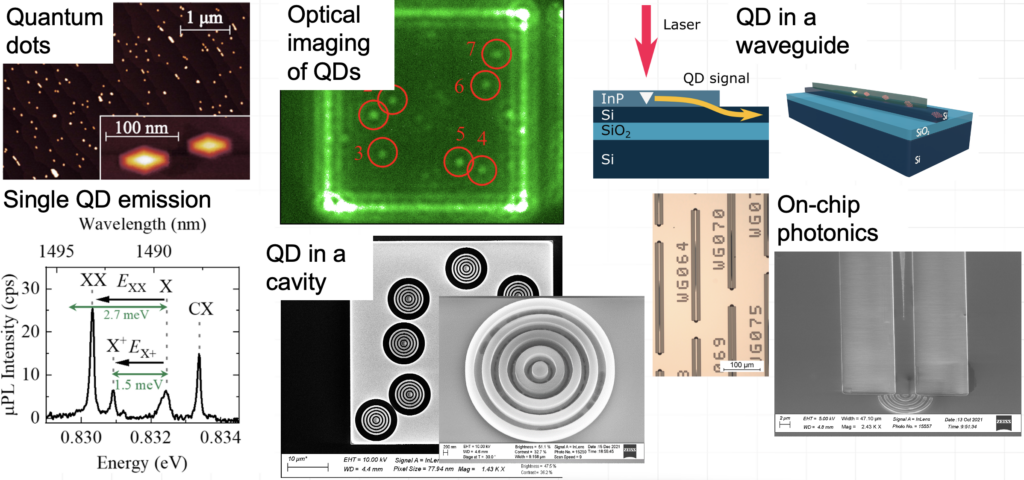
Quantum Photonics
Our research focuses on developing the quantum dots technology to obtain well-controllable quantum states generators compatible with the Si-based silicon photonic platform and the existing silica fiber-based optical networks operating in the third telecom window (emission at 1550 nm). In our group, we are developing the quantum states generators and investigating their optical properties to assess their potential for quantum photonic applications.
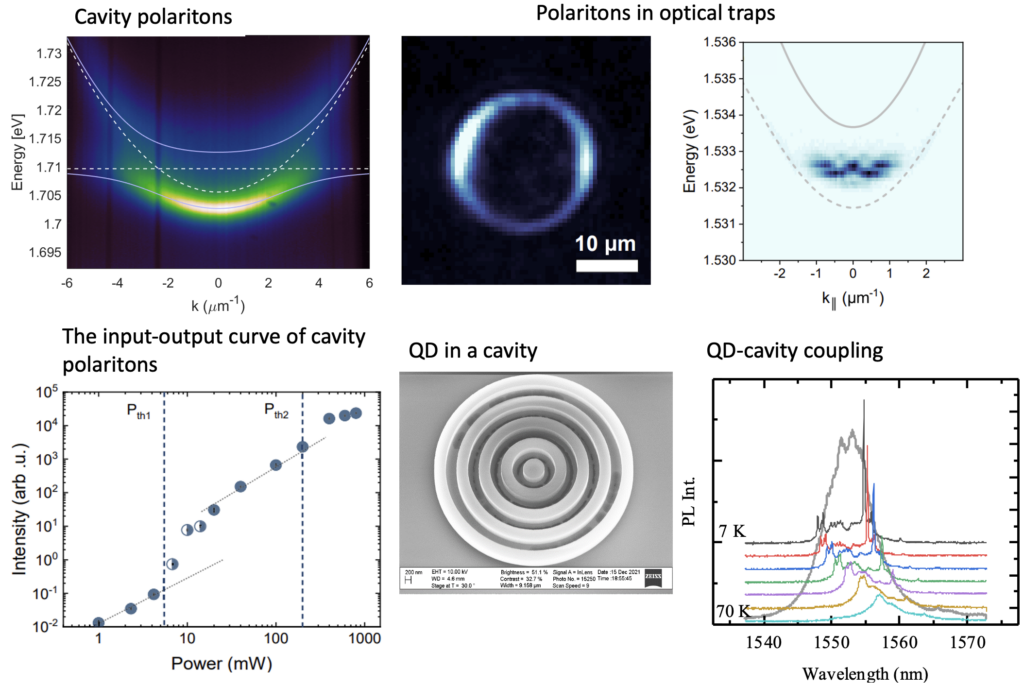
Light-matter coupling
The fundamental interaction of light and matter can lead to emerging of new particles called polaritons. These bosonic in-nature particles can condensate to a single macroscopic quantum state and can have fascinating properties. In our research, we focus on the properties of polaritons generated in semiconductor microcavities and try to transfer the fundamental knowledge toward real-life applications of polaritonic devices. In this case, we developed a unique spectroscopic technique that allows probing polaritonic states in the near-infrared spectral range.
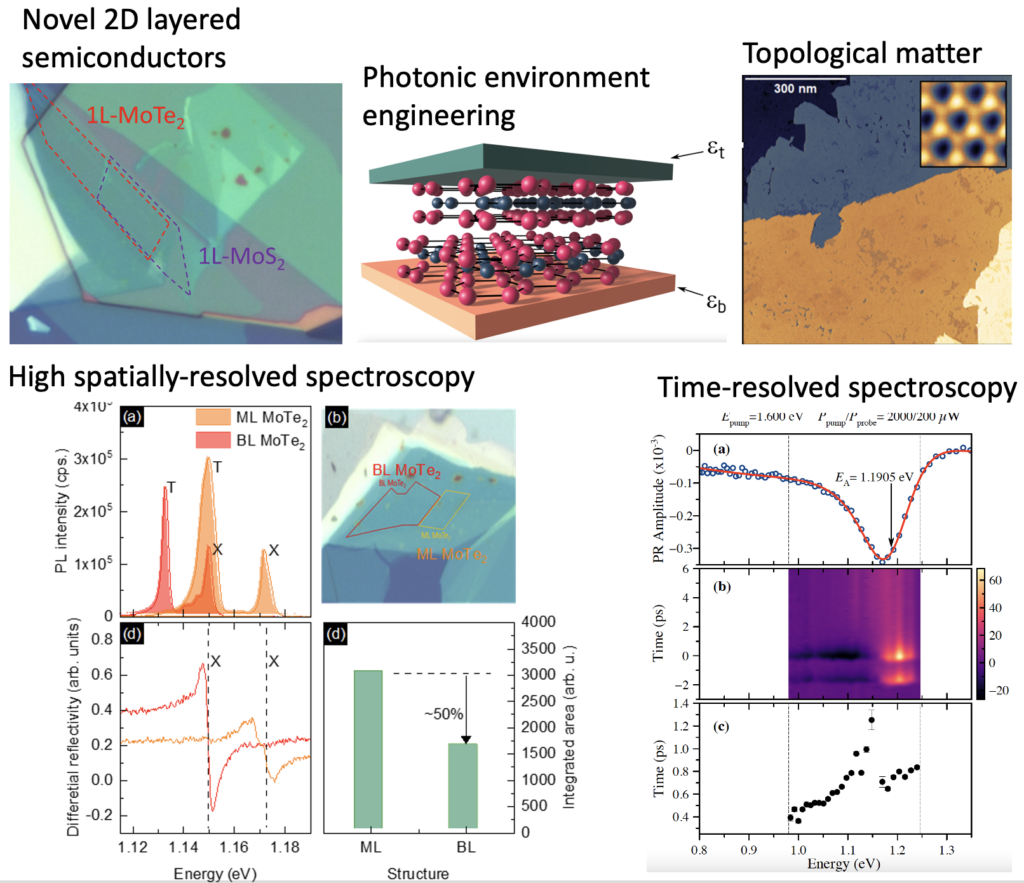
Novel 2D semiconductors and topological materials controlled by the light field
Among the countless 2D materials obtained to date, the 2D transition metal dichalcogenide (TMDC) semiconductors, with their most recognizable members MoS2, MoSe2, WS2, and WSe2, are intensively studied, showing new exciting physical phenomena promising future generation of low-energy consumption, nanoscale and efficient optoelectronic devices. In our research, we mainly focused on the fundamental properties of MoTe2 belonging to the TMDC family since it is the only material that can be potentially utilized in TMDC-based optoelectronic devices operating in the practically relevant near-infrared spectral range (above 1 μm). Lately, we have expanded our interest to other 2D materials revealing topological nature (bismuthene) and being able to interact with the infrared photon field even at room temperature.
Excitation dynamics in novel optoelectronic materials
Quantum wells and bulk semiconductor materials are still considered gain mediums for lasers and amplifiers. Plenty of ongoing research on developing new material combinations that can fulfil application-relevant requirements. In our group, we have developed several spectroscopic setups able to probe fundamental excitation in these new materials, focusing on excitation dynamics that can occur in the picosecond time scale.